
If you search for transportation advice in Seoul, almost every guide will tell you to take the subway. For many visitors, that’s genuinely good advice. Seoul’s metro is clean, reliable, and easy to navigate. But if you followed me through a typical week in Jongno, you might notice something different. Most days, I take the bus in Seoul — and I have good reasons for it.
Why I Take the Bus in Seoul: The Subway Math Doesn’t Always Work Out
My nearest subway stations are Line 1 and Line 4, both about a ten-minute walk from my apartment. Line 2 — the one that actually connects to most places I want to go — is closer to twenty minutes on foot. So by the time I factor in the walk down, the platform wait, and the almost inevitable transfer somewhere in the middle, the bus stop two minutes from my front door has already won.
This isn’t a carefully considered transportation philosophy. It’s just what makes practical sense when you live where I live.
Jongno Is a Bus Person’s Dream
From Jongno, buses run directly to Yeouido, Apgujeong, and City Hall without a single transfer. I sit down, watch the city pass by at street level, and get off close to where I actually need to be.
The route that never gets old for me is crossing the Han River by bus. The subway crosses the river too, but underground you miss most of it — a brief glimpse through dark tunnel walls. On a bus, the river opens up in front of you properly. On a clear morning with the water reflecting the sky, it genuinely makes the commute feel like something worth doing. I have taken that crossing hundreds of times and it still doesn’t feel routine.
Seoul also has more geography than people expect. Namsan tunnel runs through the mountain connecting the north and south sides of the city, and several bus routes pass straight through it. First-timers are often surprised when their bus suddenly disappears into a mountain and emerges on the other side in a completely different neighborhood. And because some bus stops are spaced further apart than subway stations, you can cover more distance per stop than you might expect — sometimes arriving faster than the map suggested.
Buses Are Quieter Than You Think
Nobody really talks about how calm buses are outside of rush hour. On weekday afternoons, I have had entire rows to myself on routes that would have packed me into a standing-room-only subway car at 8 AM. If you are not commuting during peak hours, the bus experience in Seoul is often more comfortable than people expect.
Why Most Tourists Stick to the Subway — And When That Makes Sense
Honestly, the subway is the right starting point for first-time visitors. On the subway, you will see plenty of tourists and short-term travelers who are still finding their feet. On buses, the crowd shifts — you are more likely to be sitting next to long-term expats or residents who have figured out the city well enough to navigate without a safety net.
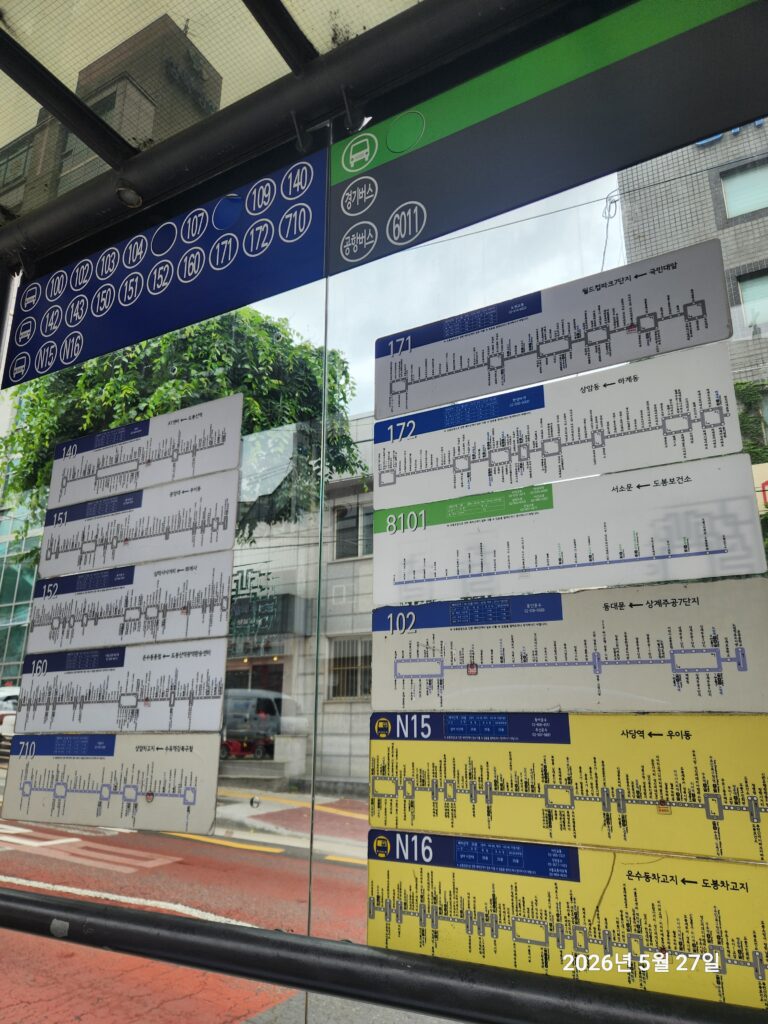
That gap exists for a reason. The route maps posted at bus stops are almost entirely in Korean — unlike subway stations, where English translations are thorough and consistent. You can see the bus number and figure out the direction, but reading the full list of upcoming stops on the shelter board requires at least some familiarity with Korean characters. It’s a small but real barrier that keeps many visitors from trying the bus at all. The subway’s English infrastructure is genuinely more complete, and for someone visiting for the first time, that matters.
But if you are staying for more than a week, or living here, learning even a handful of bus routes that connect your neighborhood to places you go regularly is worth the small learning curve.
When I Still Use the Subway
That said, I am not completely loyal. When I need to get to Jamsil or somewhere on the far east side, Line 2 wins. The bus technically goes there, but past a certain distance the travel time starts feeling unreasonable, especially when traffic builds up. And on days when the station feels too far to walk, I will grab a Ttareungyi bike and cycle there instead.
The Honest Takeaway
Seoul’s transit system works best when you stop treating it as subway versus bus and start reading the city neighborhood by neighborhood. For where I live, the bus wins most of the time. Your neighborhood might tell a completely different story — and that’s exactly the point.