
Getting around Seoul with kids on public transit is genuinely easy — but there are a few things that will catch you off guard if you are coming from another country, or even if you have just never thought about how the system actually works for families.
I have two children, and between living in Singapore and coming back to Korea, I have navigated both systems enough to notice what is different, what is better, and what requires a little advance knowledge to avoid embarrassing moments at the fare gate.
In Korea, Young Children Don’t Tap Anything
In Singapore, children get a Concession Card. Even toddlers. My younger one was so proud of that card — tapping it at the gate, watching the screen flash zero, feeling like a proper commuter. There was something about the ritual of it that kids love.
Korea works completely differently. Children under the age of six ride free, but there is no card, no tap, no ceremony. You simply walk through the fare gate together. One adult, one small child, same gate, same moment. It is practical and invisible — which is efficient, but does mean your toddler misses out on the tapping experience entirely.
Once children are old enough to pay, they use a T-Money card like everyone else and tap independently. But those early years? Just hold their hand and walk through.
Getting Your Child’s T-Money Card Set Up
The first thing I did after returning to Korea was head to a convenience store to get a T-Money card registered for my child. The process is straightforward — you give the staff your child’s date of birth, and they register it on the card, which then automatically applies the child fare every time it is tapped. No need to explain anything at the gate or to bus drivers.
For adults, this step is usually unnecessary. If you have a Korean bank card with a built-in transportation function, you can simply tap that. But children need a separately registered T-Money card to get the discounted fare applied correctly.
One thing worth knowing: if you want something a little more special than the plain convenience store version, Artbox sells T-Money cards with Korean-style designs — the kind that actually look like a small souvenir. My kids were much more enthusiastic about a card they actually liked the look of. A small thing, but it matters when you are trying to make a child feel settled in a new city.
Seoul with Kids : The Singapore Comparison That Still Surprises Me
In Singapore, the concession fare for children is tied to school enrollment, not just age. If your child attends an international school rather than a local one, the concession rate stops applying once they turn seven — switching to adult fares almost immediately, usually around March or April of the year they reach that age.
Korea does not work this way. Child fares here apply based on age regardless of which school your child attends. Coming back from Singapore, that felt like a genuine relief.
On the Bus: You Can Pay for Everyone at Once — But There Is a Catch
On Seoul buses, if you are traveling with a child who needs to pay, you can tell the driver “adults one, children one” (어른 하나, 어린이 하나) and tap your card once to cover both fares together. The driver handles it. It is convenient and saves you fumbling with two cards.
However — and this matters — if you pay this way, the transfer discount does not apply to the child’s fare. The combined payment is treated differently by the system. One more thing worth knowing: paying together works fine if you are transferring bus to bus, as long as the number of passengers stays the same. But the moment you switch to the subway, the combined fare breaks down — the subway gate cannot process it. If your journey involves both buses and trains, use separate cards from the beginning.
The Subway Gate Has Changed More Than You Think
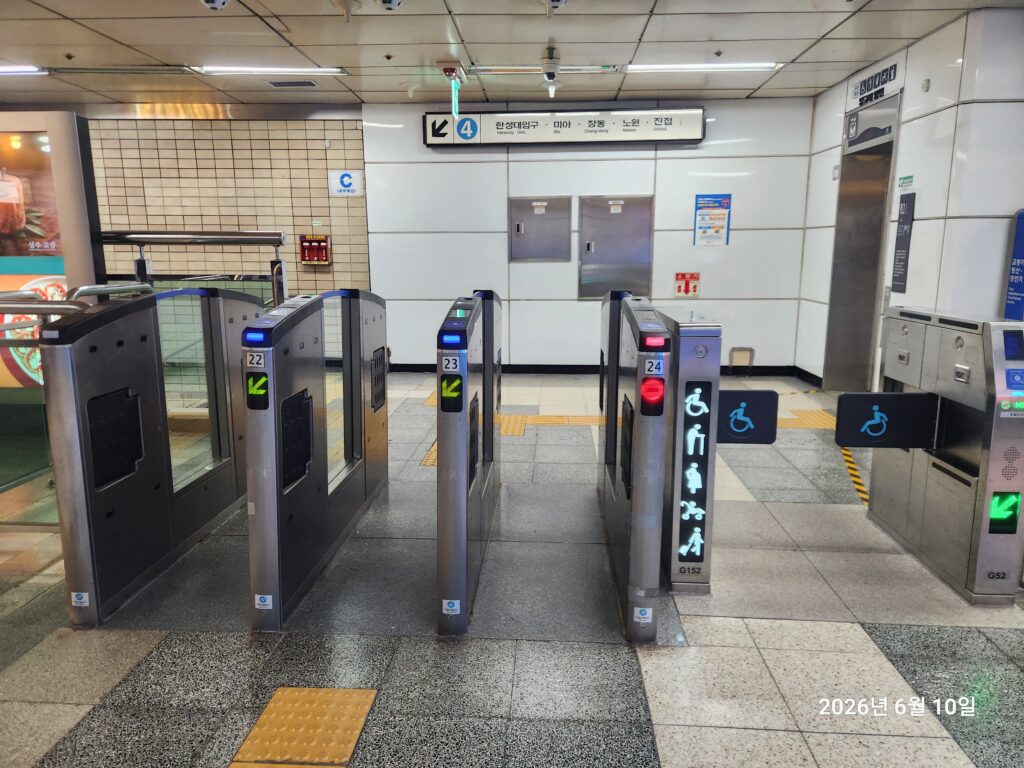
Current subway gates in Seoul open sideways — clean, flat panels that slide apart. But if you rode the Seoul subway as a child in the 1990s, you might remember something very different: a rotating bar turnstile that you had to crouch under or squeeze through. I remember doing exactly that as a kid, hunching down to get through while my mother tapped her token.
That design is completely gone now, replaced by gates wide enough for strollers and wheelchairs. The system has come a long way. If you want to feel fully prepared before your first ride, it is worth reading up on the unwritten rules that locals follow — things no official signage will tell you. [Seoul Subway Etiquette: Unwritten Rules That Will Save You From Embarrassment]
The One Thing the Bus Can’t Do That the Subway Can
On the subway, each person taps their own card individually — children included, once they are old enough to pay. There is no option to combine payment the way buses allow. If you have two children, that means two taps, two cards, two separate transactions.
It sounds minor until you are holding shopping bags, a stroller, and trying to get through a busy gate at rush hour. My advice: have the cards ready before you reach the gate, not after.