
If you look closely at Korea’s smart bus stops and street infrastructure, you will quickly realize why Seoul is consistently ranked as one of the most pedestrian-friendly smart cities in the world. When a Japanese visitor recently posted photos of Seoul’s street infrastructure on social media with the caption “Japan should spend its taxes like this too,” the post went viral almost instantly. Korean locals reading the comments felt a quiet pride—not because we had forgotten these features existed, but because we had simply stopped noticing them.
That is what happens when good design becomes part of daily life. You stop seeing it.
I use the crosswalk shade canopy near my home almost every day now. On a clear summer morning when the sun is already intense by 9 AM, stepping under that simple folding canopy while waiting for the light to change makes a genuinely noticeable difference. It is not dramatic. It is just thoughtful. And for international visitors arriving from cities where this kind of infrastructure does not exist, exploring Korea’s smart bus stops and advanced street details tends to be one of those experiences that leaves a lasting impression.
In this guide, I will walk you through the features of Korea’s public transit infrastructure that consistently surprise foreign visitors—and explain the thinking behind each one.
1. 🌡️ The Heated & Cooled Bus Stop Bench (엉뜨 의자)
This is the feature that surprises visitors most during their first Korean winter.
Sit down on what looks like a perfectly ordinary bus stop bench in December and you will immediately feel warmth rising from the seat—not unlike sitting on ondol, Korea’s traditional underfloor heating system. The bench is not heated by the sun; it is electrically warmed by a temperature controller embedded inside the composite crystal materials of the seat.
The system is highly responsive to Korea’s extreme seasonal shifts. When the ambient temperature drops below 16–18 degrees Celsius, the seat surface automatically heats up and maintains a cozy temperature of approximately 38 to 42 degrees Celsius. Conversely, during summer heatwaves exceeding 30 degrees, the smart cooling materials ensure the seat stays around 28 degrees—noticeably cooler than the scorching metal or plastic you would otherwise encounter.
The operational cost is remarkably efficient, costing around 100 KRW per hour of active use. As of 2026, these smart benches have been installed at 3,828 out of 3,928 Seoul bus stops—a coverage rate of 97.45%. If you are waiting for a bus in Seoul in any season, the bench you are sitting on is almost certainly one of these.
I’ll be honest — the heated bench almost made me miss my bus.
It was a cold morning in January, the kind where your fingers go numb within a minute of stepping outside. I sat down at the bus stop without thinking much of it, and within seconds I felt warmth rising through my coat. Not stuffy, artificial heat — just steady, quiet warmth, the kind that makes your whole body relax.
When my bus appeared down the road, I genuinely did not want to stand up. I had been pressing the backs of my cold hands flat against the seat surface, which sounds strange until you’ve done it yourself on a Seoul winter morning. The bench was warmer than my apartment floor.
That is the thing about these benches — they don’t feel like a feature. They feel like someone thought carefully about what it actually means to wait outside in January in Korea.
2. ☀️ The Crosswalk Shade Canopy (횡단보도 그늘막)
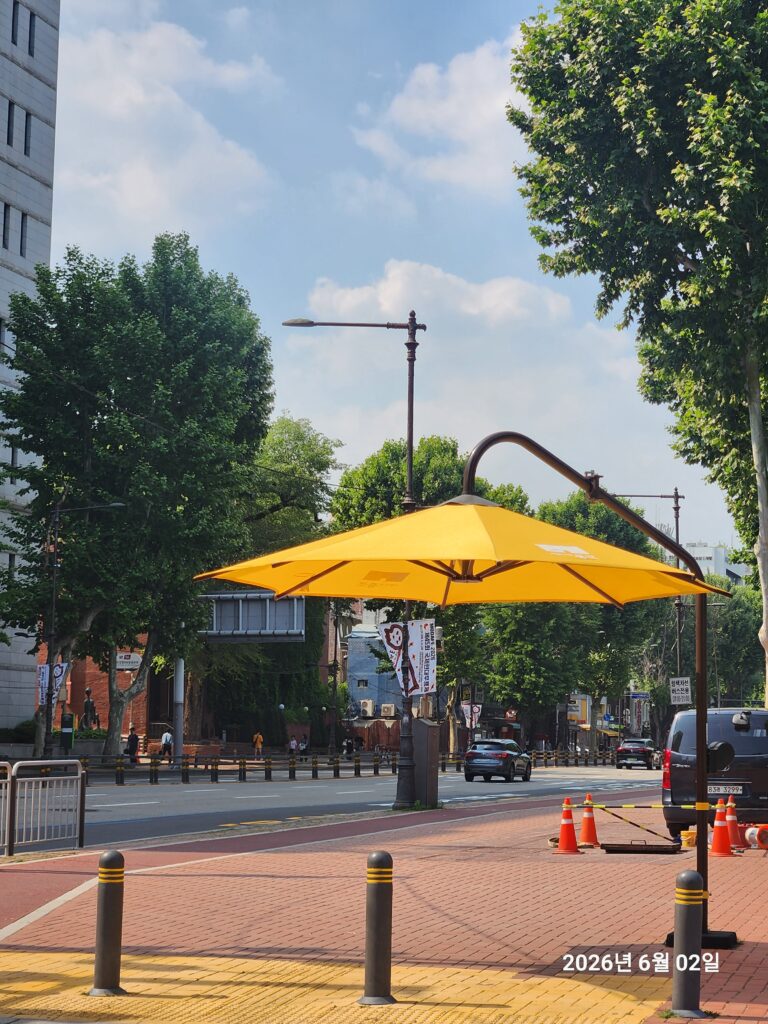
Seocho District (Seoseocho) in Seoul introduced the first fixed crosswalk shade canopy in 2015—originally dubbed the “Seoripul Hut”—and the concept has since spread across the entire nation.
The structure is a large, high-grade canopy mounted above busy crosswalk intersections. While early models were manual, modern 2026 versions deploy and retract automatically based on real-time sensors measuring temperature, wind speed, and sunlight intensity. When the sun beats down, it extends; when high winds threaten the structure, it folds away safely.
The photo above was taken on June 2nd, 2026, in front of the elementary school my child attends in Jongno, Seoul. It was genuinely hot that day — the kind of early summer heat that hits you the moment you step outside. But under that canopy at the crosswalk, it was bearable. What struck me most wasn’t the structure itself — it’s that by pickup time, every single mother waiting for their kids had naturally migrated to stand directly beneath it. Nobody organized this. Nobody announced it. The shade was there, so people used it. That’s how good infrastructure works — it just becomes part of how people move through their day.
These canopies are not rare features saved for major intersections. In my neighborhood alone, nearly every crosswalk has one. On days when the humidity is manageable but the direct sun is intense — which describes most of Seoul’s June and early July before the monsoon season — standing under that canopy for thirty seconds while the light changes makes the walk feel significantly less draining.
Japanese visitors in particular have reacted strongly to these canopies online, noting that pedestrians in Tokyo frequently struggle with extreme summer sun exposure at intersections where shade structures are rare.
3. 🪑 The Folding Street Chair (장수의자)
This small piece of infrastructure has a heartwarming origin story worth knowing.
In 2019, a police station chief in Byeollae, Namyangju—a suburban area northeast of Seoul—noticed elderly residents in his district struggling at crosswalks. The problem was simple: some older people found it physically difficult to wait through a full two-to-three-minute traffic light cycle while standing. Out of exhaustion, some would attempt jaywalking before the signal changed, leading to dangerous accidents.
His solution was the “Jangsu Chair” (Longevity Chair): a small, yellow foldable chair attached directly to the crosswalk signal post. Normally folded flat against the pole and virtually invisible, it smoothly unfolds with a gentle pull when an elderly, pregnant, or disabled pedestrian needs to sit while waiting.
Byeollae happens to be where my parents live, and I have seen these chairs in use around the neighborhood for years. What strikes me every time is how unobtrusive they are—they do not clutter the look of the street at all when folded, yet they are available precisely when and where a vulnerable pedestrian needs them.
4. 💡 LED Floor Traffic Signals (LED 바닥신호등)
Korea introduced LED lighting embedded directly into crosswalk pavement specifically in response to a documented modern behavioral shift: a growing number of pedestrians were crossing roads while looking down at their phones rather than at overhead traffic signals. Nationally nicknamed “Smartphone Zombies” (Smombies), this demographic posed a new traffic safety challenge.
These ground-level LED strips flash bright red when the pedestrian light is red and turn solid green when it is safe to cross. They match the overhead signal exactly but are positioned perfectly in the downward sightline of someone looking at a screen.
The concept has since been installed at thousands of major intersections across Seoul. The brilliant part of this design is that it accidentally accounts for multiple vulnerable user groups simultaneously: children whose eye levels sit well below standard signal heights, elderly pedestrians who have difficulty bending their necks upward, and smartphone users who are distracted.
5. 🏠 Smart Climate Shelters (스마트쉼터)
Taking the concept of Korea’s smart bus stops to the absolute extreme, Seoul has been aggressively rolling out fully enclosed Smart Climate Shelters (스마트쉼터) at high-traffic transfers. These are not mere bus stops; they are fully enclosed glass tech-cabins equipped with automated air conditioning and UV cooling fans in summer, ceiling heaters in winter, medical-grade air purifiers, CCTV security cameras, emergency call buttons, wireless phone charging pads, and free public Wi-Fi.
The shelters were even selected as an [OECD public sector innovation case study], giving a sense of the international attention they attract.
While construction costs run approximately 65 million to 100 million KRW per unit, the integration of safety, climate control, and real-time transit information represents a genuinely human-centric approach to urban planning.
Having lived abroad in a tropical expat hub where covered walkways are treated as essential infrastructure against sudden daily downpours, I deeply understand the logic of designing public space around weather.
Korea’s weather challenges are different—our extreme cold is concentrated in winter and intense heat in summer—and these smart shelters solve that problem beautifully. Inside these shelters, you can escape the harsh weather, keep an eye on the digital screen displaying real-time bus arrivals, and wait in total comfort until your bus reaches the stop.
Once your bus arrives, make sure you know the local boarding etiquette by checking out my complete guide: [How to Ride a Seoul Bus: Colors, Seat Manners, and Hidden Local Rules].
Why This Matters for Visitors
None of these features will appear in standard tour itineraries or “Top 10 Attractions in Seoul” lists. But they are precisely what makes navigating this city as a pedestrian feel fundamentally different from navigating most other major global mega-cities.
If you arrive expecting Seoul to feel overwhelming—and it can, particularly around busy subway exits during rush hour—these small infrastructure details have a way of making the city feel incredibly considered and empathetic. The heated bench at 7 AM in January. The canopy that shelters you from a July heatwave. The chair folded against a pole for someone’s grandparents.
Good urban design at street level is rarely loud. It just makes daily life slightly easier for the people using it—and after a while, you stop noticing it entirely. Until someone from somewhere else reminds you how special it is.