
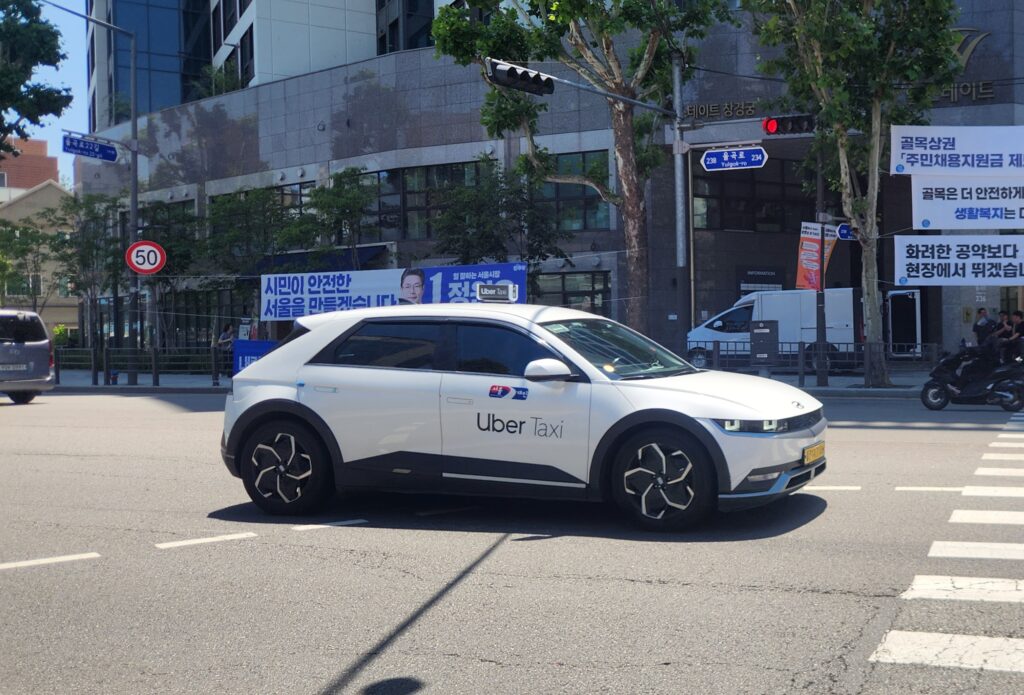
If you are looking for a comprehensive Korea Taxi Guide to navigate the bustling streets of Seoul, you might be surprised by how fast things are changing in 2026. Just a few days ago, I spotted an Uber taxi driving through the city. The word “Uber” was printed clearly on the side of what looked like a perfectly ordinary Korean taxi, and it genuinely caught me off guard. For anyone who has lived in Korea long enough to remember the years when Uber was essentially banned here, seeing that logo on a Seoul street felt like a small cultural shift happening in real time.
For international visitors, this Korea Taxi Guide brings genuinely exciting news. While Koreans have largely built their lives around Kakao T, the idea of stepping off a plane and opening the same Uber app you use back home—without downloading anything new or setting up a Korean account—is a significant improvement in the experience of arriving in Korea.
But before we get into apps, let this Korea Taxi Guide walk you through what you will actually see on Seoul’s streets, because Korean taxis come in more varieties than most visitors expect.
1. Decoding Korean Taxi Colors
Korean taxis are not all the same, and the color of the vehicle tells you something important about the service level and price you can expect.
-
🟡 Orange/Yellow Taxis (일반택시 — Standard): The most common taxi you will see on Seoul streets. These are standard metered taxis operated by individual drivers or smaller companies. Service quality varies significantly from driver to driver—more on that in a moment.
-
⬛ Black Taxis (모범택시 — Premium): The black taxi, known as Mobeom Taxi, is Korea’s premium tier. These vehicles are noticeably larger and cleaner, and the drivers have undergone additional training and certification. The base fare is roughly double that of a standard taxi, but the service difference is real.
-
🔵 Blue or Silver Taxis: These are also standard taxis, with colors varying by company or region. Treat them the same as orange taxis in terms of service expectations.
-
🚐 Jumbo Taxis (대형택시): Large vans accommodating up to six or seven passengers. Useful for groups or travelers with significant luggage. Fares are higher than standard taxis.
2. The Honest Truth About Standard vs. Premium Taxis
I have taken Korean taxis hundreds of times over the years, and I will be straight with you: standard taxis in Korea are a mixed experience.
On a good day, you get a driver who is professional, takes the most direct route, and gets you there without incident. On a less good day, you might find yourself in a car that smells of cigarette smoke, with a driver blasting whichever radio station or music he personally enjoys, completely indifferent to whether you mind. I want to be clear—many drivers are perfectly fine, and genuinely good experiences are common. But the variance is real, and if you have taken taxis in Japan, where near-universal professionalism is simply the standard, Korean standard taxis can feel inconsistent by comparison.
The Mobeom black taxi is a completely different category. I have taken one exactly once, and the contrast was immediately obvious. The driver helped with my bags without being asked, adjusted the environment to my comfort without prompting, and the entire ride had the feeling of a service that was actively trying to make the experience good rather than just completing a transaction. It costs more—roughly double the standard meter—but if you are arriving tired after a long flight or heading somewhere important, it is worth considering.
3. Uber in Korea: What Changed and Why It Matters for Visitors
What you see on Seoul’s streets today labeled as “Uber” is the result of a long and complicated history. Uber originally entered Korea in 2013 but faced immediate legal challenges, as its core ride-sharing model conflicted with Korean transportation law. For years, it operated in a limited capacity under various workarounds.
In March 2024, the service was formally rebranded from its Korean joint venture name (UT) back to the global Uber brand, and critically, the global Uber app now works directly in Korea without requiring a separate Korean app or account setup.
For international tourists reading this Korea Taxi Guide, this is meaningful. If you already have the Uber app on your phone with your payment details saved, you can open it in Seoul and request a ride immediately. The vehicles you will be matched with are licensed Korean taxis—not private cars—so the legal situation is fully resolved.
One honest note: Uber in Korea is still growing its driver base, and matching times can occasionally be longer than Kakao T during peak hours. But for visitors who do not want to set up a Korean app or deal with payment method issues, having Uber available as a familiar fallback is genuinely useful.
4. Kakao T: Still the Local Standard
For anyone willing to spend five minutes setting up a Korean app, Kakao T remains the dominant platform and generally offers faster matching and more driver availability than Uber at this stage.
I spent several years living abroad where Grab and Gojek were daily essentials—apps very similar to Kakao T in how they work. Coming back to Korea, Kakao T felt immediately familiar. The mechanics are identical: set your pickup point, confirm your destination, watch the driver approach on the map. For visitors comfortable with ride-hailing apps in general, Kakao T is not difficult to set up.
💡 For a complete step-by-step guide on setting up Kakao T with a foreign phone number and international credit card, check my detailed guide here: [How to Use Kakao T as a Foreign Tourist in Korea]
5. A Brief Word on Tada
You may encounter the name Tada in conversations about Korean mobility apps. Tada launched in Korea as a premium ride service and built a strong following before regulatory challenges forced significant changes to its model. Interestingly, while Tada has become less prominent in Korea, the service expanded into Singapore, where it operated successfully alongside Grab and Gojek. I used Tada myself during my time abroad—a Korean app that turned out to be more visible overseas than at home, which is a quietly strange situation.
6. Practical Tips for Taking Taxis in Korea
-
🚫 Avoid Terminal Scams: Ignore anyone who approaches you inside the arrival terminal. Always use official taxi stands outside the arrivals hall. Unofficial drivers are unlicensed and unregulated.
-
💳 Payment Methods: Most taxis accept card payment, including T-Money cards and standard credit cards. Confirm before departure if you are unsure, especially in smaller cities.
-
📱 Use Apps Over Hailing: Use Kakao T or Uber whenever possible rather than hailing from the street. App-based bookings provide a clear fare estimate, a record of your ride, and a way to contact the driver or report issues if needed.
-
🌙 Late-Night Surcharge (Updated): The late-night surcharge applies between 11:00 PM and 4:00 AM. Fares increase by 20%, but can spike up to 40% during the peak hours of 11:00 PM to 2:00 AM.
-
🧳 Luggage Loading Culture: As noted in my airport transit guide, Korean taxi drivers commonly remain seated while passengers load their own bags. This is standard local practice rather than rudeness—be prepared to handle your luggage independently. If you need a refresher on navigating your way from the arrivals terminal, see [How to Get from Incheon Airport to Seoul (2026 Complete Guide)]
-
⬛ Choose Mobeom for Comfort: Book a Mobeom black taxi for airport transfers, important meetings, or any occasion where you want reliable, professional service without the variance of the standard tier.
Summary Checklist for Korean Taxis
-
Orange and standard-colored taxis are metered, widely available, and variable in service quality.
-
Black Mobeom taxis cost roughly double but offer significantly more consistent and professional service.
-
Uber now works in Korea via the standard global app—no separate setup required for international visitors.
-
Kakao T remains the dominant local platform with the largest driver pool and fastest matching times.
-
Always use official taxi stands, never accept offers from drivers approaching you inside terminal buildings.
-
Late-night fares increase by 20% to 40% between 11:00 PM and 4:00 AM.
-
Expect to load your own luggage—this is normal Korean taxi culture, not a reflection of service quality.