
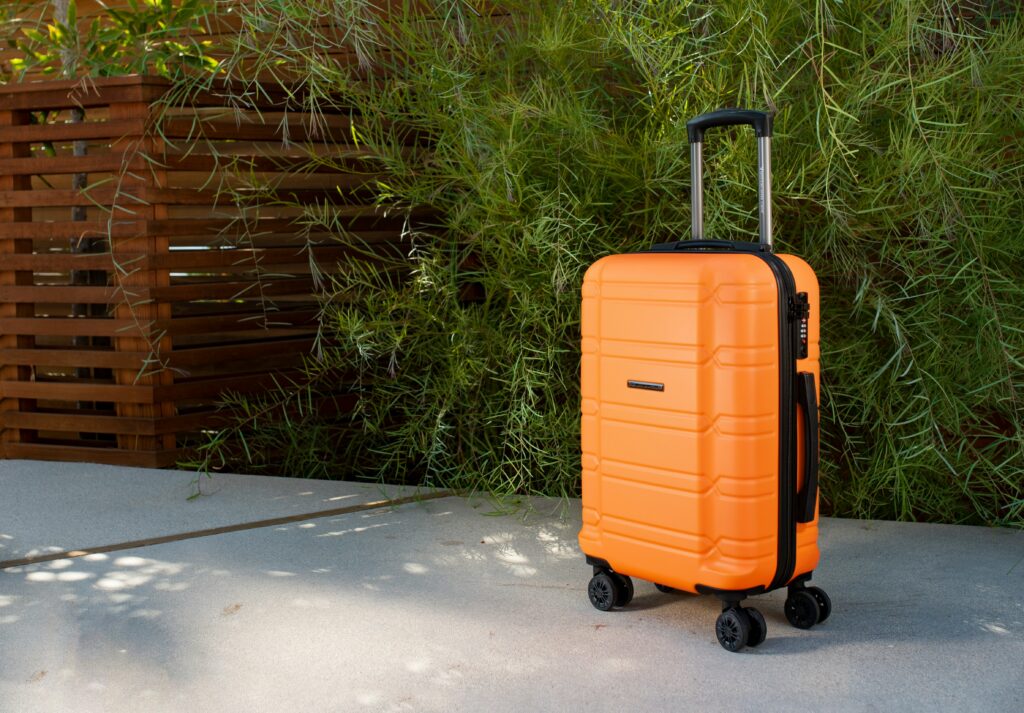
If you need to store your luggage in Seoul on your final travel day, deciding where to leave your heavy bags can make or break your trip.
Whenever I travel abroad, I always leave my suitcases at the hotel front desk after checking out—most standard hotels in Seoul will happily do this for you for free. But what if you are staying in an Airbnb? Most Airbnb hosts in Korea cannot store your bags after 11:00 AM because they need to clean the room for the next guest. I learned this firsthand on a family trip when we stayed in an Airbnb and had to get creative—we ended up renting a car just so we could leave our bags locked in the trunk while we spent the rest of the day exploring.
And dragging heavy luggage through Seoul’s subway system is no small feat. I know this not from suitcases, but from something equally bulky: a stroller. When my children were young, I commuted daily on the Seoul subway with a pram, heading to and from my workplace daycare. Even during rush hour, finding an elevator was never guaranteed. I would spend extra time at every transfer hunting for the lift, waiting behind long queues, and navigating tight corridors. If a stroller felt that exhausting, imagine doing it with two massive suitcases.
This is why knowing your options is not just convenient—it is essential for survival. In this updated 2026 guide, I will break down your best options so you can enjoy your last day completely hands-free.
1. Short-Term Storage: The Subway T-Locker System
For quick storage (under 4 hours), almost every single subway station in Seoul (Lines 1 through 9) features digital lockers called T-Locker. They operate via touchscreens supporting English and accept foreign credit cards or T-Money.
-
Small (S) / Backpacks: 2,000 KRW (Base 4 hours) + 500 KRW/hour
-
Medium (M) / Cabin Bags: 3,000 KRW (Base 4 hours) + 800 KRW/hour
-
Large (L) / 28″+ Suitcases: 4,000 KRW (Base 4 hours) + 1,000 KRW/hour
A Local Warning on Major Stations: Lockers at major KTX hubs like Seoul Station or Yongsan Station are notoriously packed. If they are full, don’t panic—simply walk down into the connected subway transit corridors (Lines 1, 4, or Gyeongui-Jungang) where you will find much emptier T-Locker zones.
2. The Ultimate Hack: T-Luggage (Same-Day Airport Delivery)
If it is your last day and you want your bags sent directly to the airport while you shop, you need to use T-Luggage.
Operated by the Seoul Metro, this service is available at 9 major strategic subway stations: Seoul Station, Myeongdong, Hongik University (Hongdae), Gimpo Airport, Gangnam, Jamsil, Sports Complex, Jongno 3-ga, and Suseo.
While you can store bags there physically, their best feature is Airport Shipping. For roughly 20,000 to 31,000 KRW (depending on suitcase size and weekday/weekend rates), they will safely deliver your luggage straight to Incheon International Airport.
3. T-Luggage vs. City Airport Terminal: Which is Better?
Many tourists confuse T-Luggage with the City Airport Terminal (located at KTX Seoul Station). Both get your bags to the airport, but they operate completely differently. T-Luggage is vastly more flexible for most travelers.
| Feature | KTX City Airport Terminal | T-Luggage Service |
| Drop-off Location | Only at KTX Seoul Station | 9 major subway stations across Seoul |
| Where is your bag? | Sent straight to the airplane (You cannot access it at the airport) | Sent to an airport counter (You pick it up, meaning you can add last-minute duty-free shopping inside) |
| Cost Structure | Luggage handling is free, but you must buy an AREX Express Train ticket (13,000 KRW) | Delivery costs 20,000 – 31,000 KRW, but you can travel to the airport however you like (Bus, taxi, etc.) |
| Airline Restrictions | Strict airline limits (Only valid if flying with specific airlines like Korean Air, Asiana, etc.) | No airline restrictions at all because you check-in at the airport yourself |
4. Hotspot Warning: Seongsu Station (Line 2) Congestion
If you are planning to visit Seongsu Station—often called the “Brooklyn of Seoul” due to its trendy pop-up stores and cafes—be prepared for extreme crowds.
Currently, Exit 3 at Seongsu Station is severely bottlenecked. During rush hours and weekend afternoons, the lines just to get to the escalator can be painfully long. If you are carrying even a small bag, navigating this specific exit is highly uncomfortable.
What’s changing? To fix this, Seoul Metro is currently constructing a brand-new exit on the eastern end (toward Konkuk University Station, leading to Yeonmujang 11-gil), scheduled to open by the end of 2026. Until then, try to avoid traveling to Seongsu Station during peak hours if you are carrying any baggage at all.
Summary Checklist for Luggage in Seoul
-
If you stay at a hotel, ask the front desk first. If you stay in an Airbnb, plan to use T-Lockers or T-Luggage.
-
Avoid using subway elevators with heavy bags during peak hours; they are very small and reserved for local elderly residents.
-
Use T-Luggage if you want to drop your bags at a major subway station like Myeongdong or Hongdae and pick them up at Incheon Airport later.
-
Choose the City Airport Terminal only if you want to complete your airline check-in early at Seoul Station and are flying with a supported carrier.
-
If you are taking a long-distance train after dropping off your bags, make sure to read my guide on [Is the KORAIL Pass Worth It? An Honest Financial Breakdown] to map out your transit budget.