
When people picture navigating South Korea’s capital, they usually think of the extensive subway lines and crowded buses. However, there is a third option that locals use constantly and tourists almost always overlook: cycling. Living in the heart of Jongno, renting a public Ttareungyi bike in Seoul has genuinely replaced short bus trips for my daily commute. On many days, cycling from my home to Myeongdong is actually faster than walking to a bus stop, waiting through traffic, and navigating the crowds.
In this comprehensive 2026 guide, I will cover everything you need to know about Seoul’s public bike system as an international visitor, decode the hidden “unlimited time reset” trick, and evaluate the realistic rules for sidewalks and electric bike alternatives.
1. What is Ttareungyi (따릉이)?
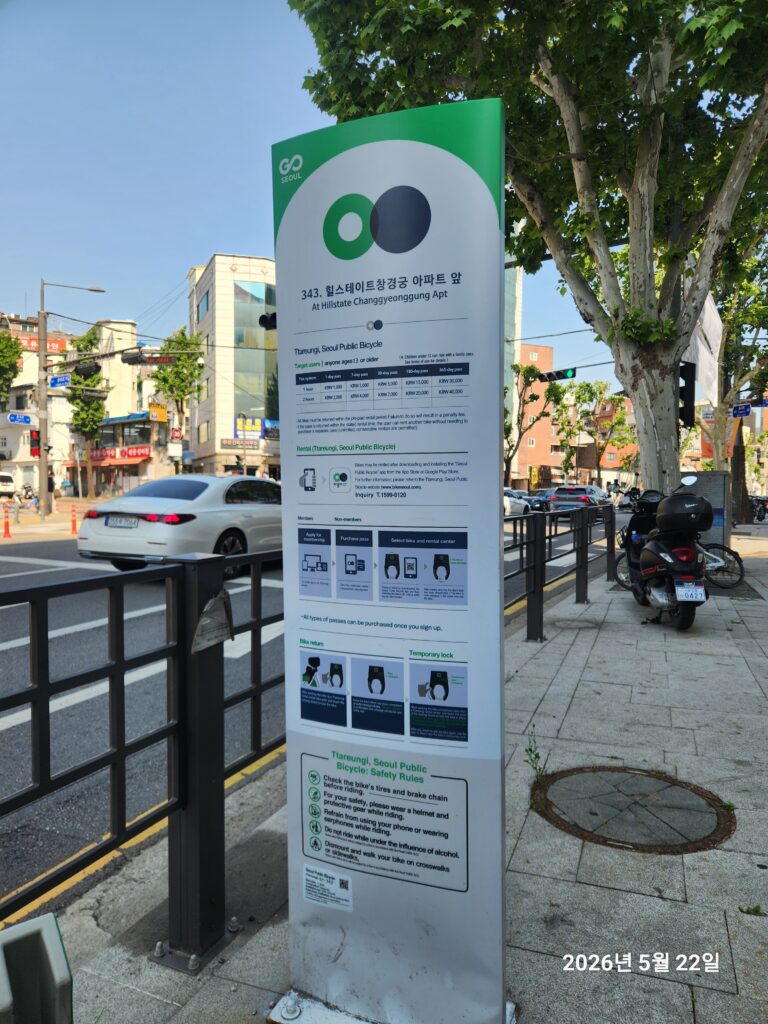
Ttareungyi is Seoul’s official public bicycle-sharing system, operated efficiently by the Seoul Metropolitan Government. The name playfully mimics the onomatopoeia for a classic Korean bicycle bell—“Ttareung-ttareung” (ting-a-ling)—reflecting how cheerfully embedded this system is in daily Seoul life.
These bright green and white bikes are docked at thousands of locations across the city. They are particularly dense near subway exits, major central landmarks like Jongno, Mapo, and Yeongdeungpo, and all along the Han River paths. The network is so tightly woven that in my neighborhood, you are rarely more than a 2-minute walk from an active docking station.
2. The Pricing System: The “Unlimited 1-Hour” Loop Trick
Ttareungyi offers incredible value, but you need to understand how the voucher system actually handles time allowances to maximize your wallet.
| Pass Type | Price | Time Allowance per Session | Best For |
| 1-Hour Single Pass | 1,000 KRW | 60 minutes | Short tourist hops |
| 2-Hour Single Pass | 2,000 KRW | 120 minutes | Extended riverside rides |
| 1-Day Premium Pass | 5,000 KRW | Unlimited 2-hour sessions for 24h | Full day exploring |
| Annual Pass (Local) | 30,000 KRW | Unlimited 1-hour sessions all year | Expats & Residents |
💡 The Local Insider Trick:
Your voucher time limit is not the maximum time you can use a bike in a day; it is simply the maximum time allowed per single session. If you purchase a 1-Hour Single Pass (1,000 KRW), you can ride for 45 minutes, return the bike securely to any Ttareungyi station in the city, and your timer completely resets. You can immediately unlock another bike, and a brand-new 60-minute window begins! As long as you return the bike within the time limit each time, you can ride across Seoul all day long for just 1,000 KRW.
Living in Jongno, I use the annual pass at 30,000 KRW per year. To put that in perspective, that is equivalent to just 10 single subway rides (or 5 round-trips) per month for unlimited cycling access across the entire city for a full year. For short-term tourists, the 1,000 KRW pass is more than enough.
3. How Foreigners Can Rent a Ttareungyi Bike in Seoul : Step-by-Step
Seoul has made the rental process exceptionally foreigner-friendly. You do not need a Korean phone number or a resident ID to ride.
-
Download the App: Search for Seoul Bike (따릉이) in the App Store or Google Play Store.
-
Switch Language: Tap the language selector (Globe icon) in the top-right corner of the home screen and choose English.
-
Select Foreigner/Non-Member: Tap on the “Foreigner” bar at the bottom.
-
Choose Your Pass & Pay: Select your desired pass. The app fully supports international credit cards (Visa, Mastercard, JCB) as well as Alipay and WeChat Pay for global travelers.
-
Unlock via QR: Once paid, locate an available bike at a station, tap “Rent” in the app, and scan the QR code located directly underneath the bicycle seat. The electronic lock will click open automatically.
🔄 Returning the Bike: Simply push the bike firmly into any empty docking slot at any Ttareungyi station across the city. Manually slide the lock lever down until you hear a clear audio beep and receive an app notification confirming a successful return.
-
The Sidewalk Dilemma: In South Korea, bicycles are legally classified as vehicles, meaning you should ideally ride in designated bike lanes or on the right edge of the regular road. While you might occasionally see locals cruising carefully on wide sidewalks when roads are too dangerous, riding on pedestrian sidewalks is technically illegal and you can be held strictly liable in the event of an accident. If a road lacks a bike lane and forcing yourself into heavy traffic feels unsafe, it is always best to dismount and push your bike along the sidewalk.
-
Navigate with Naver Map: Google Maps does not support accurate cycling navigation in South Korea due to local security regulations. Always download Naver Map or KakaoMap, switch to the dedicated “Cycling” icon, and it will guide you exclusively via dedicated riverside paths and traffic-free bike alleys.
-
The Cheonggyecheon Highway: If you want a scenic, traffic-free short-cut through central Seoul, use the dedicated bike track running alongside the Cheonggyecheon Stream. It connects Jongno to Myeongdong and the east side of the city beautifully and quickly.
5. Electric Bike Alternatives: Swing, Kakao T Bike, & The Driver’s License Trap
In recent years, dockless electric bikes operated by private tech companies have become highly visible on Seoul’s streets, with popular brands like Swing (씽씽) and Kakao T Bike leading the market.
These bikes feature pedal-assist electric motors that make climbing Seoul’s notorious hills—like those in Bukchon Hanok Village, Itaewon, or the slopes leading up to Namsan—completely effortless. Furthermore, because they are dockless, you can park them virtually anywhere within their service zones without hunting for an official station.
🚨 CRITICAL WARNING FOR FOREIGNERS (Traffic Laws):
Before you attempt to rent a private electric bike or e-scooter in Korea, you must know that South Korean law mandates a valid driver’s license or an International Driving Permit (IDP) to legally operate electric personal mobility devices. > Riding an e-bike with a throttle system without a valid license can result in heavy police fines (up to 100,000 KRW) or severe legal complications in the event of an accident. Furthermore, these private apps almost always require a verified Korean phone number and a domestic payment method (KakaoPay, Toss) to register, making them highly impractical for short-term tourists.
Summary Checklist for Traveling via Bike
-
Rent a Ttareungyi Bike for cheap, reliable, and legal city cruising without needing a driver’s license.
-
Download the official Seoul Bike app and pay via international card, Alipay, or WeChat Pay without signing up.
-
Remember the 60-minute reset rule to stretch a 1,000 KRW pass into an all-day travel option.
-
Always listen for the beep sound and check your phone notification when docking a bike to ensure you aren’t overcharged.
-
Avoid private electric bikes (Swing/Kakao) unless you possess a verified Korean SIM card and an International Driving Permit.
-
Switch your navigation exclusively to Naver Map‘s cycling mode to find the safest designated bike paths and avoid sidewalk penalties.