
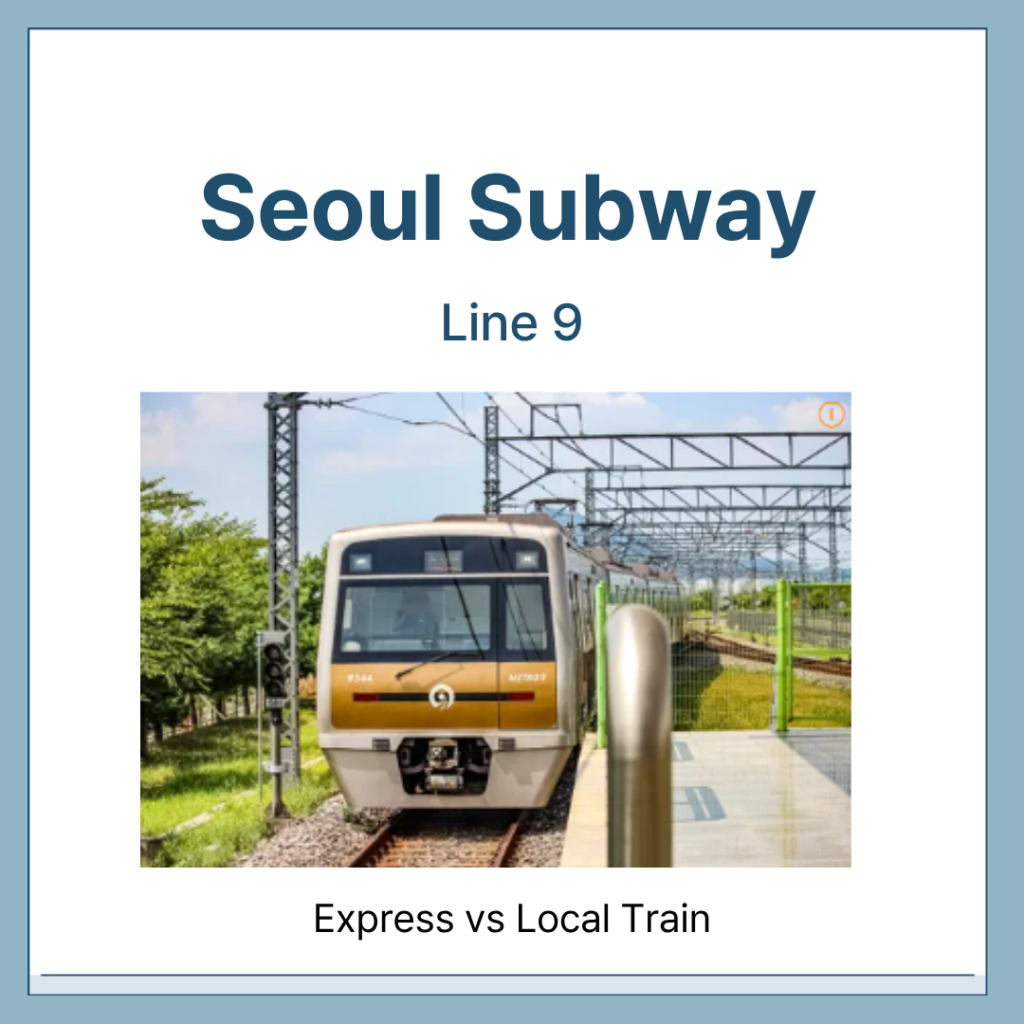
If there is one subway line in Seoul that perfectly captures the city’s obsession with speed, it is Seoul Subway Line 9—the Gold Line.
Let me be upfront about something: I almost never take the Express during rush hour myself. Standing packed into a crowded train is sweaty work—even in the middle of winter. My personal rule is simple: unless I am genuinely running late, I take the Local train and accept the extra minutes. The frustrating part is that once a few Express trains pass, the Local platform gradually fills up with everyone else who also skipped the Express, and suddenly the “comfortable” Local is not so comfortable either. Watching the Express zoom past while you fall further behind schedule has a particular way of testing your patience.
But here is what I have come to accept: it really comes down to personality and situation. Time-is-money commuters will cram themselves into the Express without hesitation and endure the crush for the speed advantage. If you are traveling with children, carrying heavy luggage, or simply have no urgent deadline, the Local is almost always the better choice—less crowding, less stress, and you actually arrive feeling like a human being.
In this 2026 guide, I will explain exactly how the Express and Local system works, when each one makes sense, and how to avoid the mistakes that catch most first-time visitors off guard.
1. Understanding the Gold Line: Why Line 9 is Different
To understand this specific route, you first need to understand Korea’s famous “Pali-Pali” (빨리빨리) culture. Koreans value speed and efficiency above almost everything else in daily life. Seoul Subway Line 9 was built with this mindset at its core, introducing a dual-speed system that no other Seoul subway line operates quite the same way.
The result is that Line 9 cuts straight through the heart of Gangnam and connects directly to Gimpo Airport—the main hub for domestic flights—in a way that feels almost unfairly fast when the Express is running smoothly. Real estate prices near designated Express stations are measurably higher than those near Local-only stations, which tells you everything about how seriously Koreans take this line.
2. Express vs. Local: What is the Difference?
Both train types run on the exact same tracks and stop at the same platforms. You must look carefully at the signs before stepping through the doors.
-
🟢 Local Train (완행): Stops at every single station along the line. Displayed in green or plain white text on the arrival screens. Comfortable during off-peak hours, manageable during rush hour if you time it right.
-
🔴 Express Train (급행): Skips minor stations and stops only at major hubs such as Gimpo Airport, Gayang, Dangsan, Yeouido, Noryangjin, and Sinnonhyeon. Displayed in bright red on the platform screens, with a distinct red stripe on the train itself. Taking the Express can cut your travel time nearly in half—getting from Gimpo Airport all the way to Gangnam in under 40 minutes.
3. 🚨 The Dark Side of the Express: Rush Hour Reality
While the Express sounds perfect on paper, the morning rush hour between 7:30 AM and 9:00 AM transforms it into what Korean commuters genuinely call “Hell-Chul” (지철—Hell Subway).
Because everyone is infected with the Pali-Pali spirit, thousands of commuters will deliberately let a half-empty Local train pass by just to squeeze themselves into an already suffocating Express. The crowding is severe enough that a viral post warning parents not to bring young children onto the Line 9 Express during morning rush hour gained massive agreement from Korean commuters online.
This is not an exaggeration. Adults get physically pinned against one another, and smaller children can easily get trapped below shoulder level where breathing becomes genuinely difficult. If you are traveling with kids, strollers, or large suitcases during these hours, take the Local. It will add roughly 15 minutes to your journey, but you will arrive in one piece and in a reasonable mood.
4. Smart Hacks for Riding Line 9
-
🖥️ Read the platform screens carefully: The digital hanging signs clearly show whether the approaching train is Express (급행 in red) or Local (완행 in green). Never assume—always check before stepping on.
-
🔄 The cross-platform switch: If you board a Local train but decide you want to catch the next Express, you can sometimes switch seamlessly at major stations like Magongnaru or Dangsan. The Local pulls up on one side of the platform and waits while the Express arrives on the other side. You can step out of one and walk directly into the other without tapping your card again.
-
⏰ Avoid the core peak window: If you absolutely must take the Express to catch a flight at Gimpo, try to travel before 7:15 AM or after 9:15 AM to avoid the worst of the crush.
-
🧳 Luggage and strollers: During off-peak hours the Express is perfectly manageable even with bags. Rush hour is a different story entirely—stick to the Local without exception.
5. The Transfer Gate: Don’t Panic
When transferring to or from Line 9 at stations like Gimpo Airport, Noryangjin, or Express Bus Terminal, you will walk through what looks like a second set of exit turnstiles in the middle of a connecting corridor. Many first-time visitors freeze here, convinced they are accidentally leaving the station and about to lose their fare.
You are not. These are transfer gates that exist because Line 9 was built with private funding and is operated by a different company from Lines 1 through 8. The barriers are purely there to track passenger numbers between the two operators for revenue-sharing purposes. Just tap your card and keep walking. Nothing extra is deducted from your balance.
💡 For a complete masterclass on navigating the broader transit network, check my master guide: [Seoul Subway Guide: How to Ride, Transfer, and Never Get Lost]
Summary for Line 9
-
Look for red signs and red train markings to identify the Express—green means Local.
-
Use the Express for a fast 40-minute connection from Gimpo Airport to Gangnam during off-peak hours.
-
Avoid the Express entirely between 7:30 AM and 9:00 AM if you have children, strollers, or large luggage.
-
If you miss your preferred train type, use the cross-platform switch at Magongnaru or Dangsan to change between Express and Local without re-tapping.
-
At Line 9 transfer gates, tap your card and walk through confidently—no extra charge applies.
-
When in doubt, take the Local. Arriving 15 minutes later is far better than arriving exhausted and crushed.