
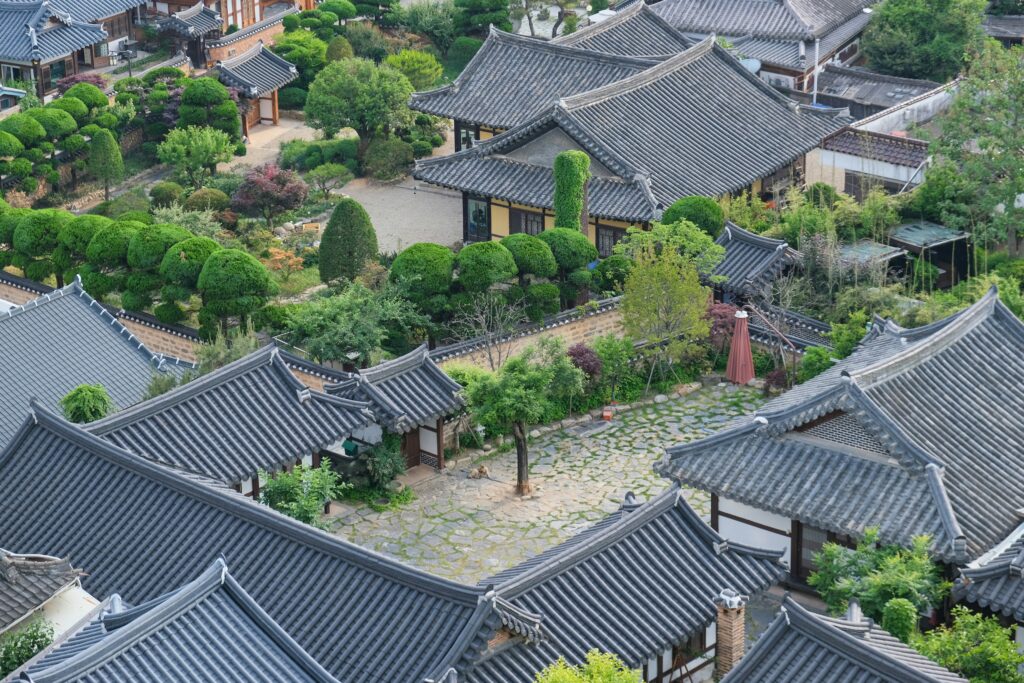
If you are currently figuring out how to get from Seoul to Jeonju by Bus for your upcoming itinerary, you are about to head toward one of the most culturally rewarding destinations in South Korea. If you ask any South Korean local where to go for the most satisfying combination of ancient history, traditional wooden architecture, and genuinely outstanding regional food, Jeonju will almost always sit at the top of the list. This is not a synthetic destination curated strictly for international tourists—it is a cultural city that Koreans themselves choose for domestic weekend getaways which is perhaps the strongest endorsement any travel spot can receive.
Our family trip to Jeonju remains one of my absolute favorite travel memories. The city is beautifully compact enough to explore comfortably over a weekend, yet rich enough in heritage, flavors, and night markets that you never feel like you are running out of things to discover.
In this comprehensive 2026 guide, I will cover the most affordable, practical, and preferred way to reach the city via a Seoul to Jeonju by Bus route, and share the local insights that make this culinary capital worth every single mile.
1. Bus vs. KTX: Why the Express Bus Wins for Most Travelers
When planning this trip, many first-time visitors naturally look up the high-speed KTX train first. There is indeed a direct KTX service running from Yongsan Station straight to Jeonju Station, and it is genuinely fast at around 1 hour 40 minutes. However, there are two practical drawbacks worth knowing: weekend and holiday tickets sell out quickly, sometimes days in advance, and Jeonju Station drops you off relatively far from the historic Hanok Village center—meaning you will need an additional taxi or bus ride regardless.
For this reason, taking the premium express bus is not just the cheapest option—it is often the most practical, reliable, and stress-free route for most independent travelers.
| Travel Method | Total Travel Time | Approximate One-Way Fare | Practical Convenience |
| Express Bus (Direct) | Approx. 2.5 – 3 hours | 16,000 – 26,000 KRW | ✅ Highly Recommended. Drops you off right near the city core. Plenty of departures. |
| KTX High-Speed Train | Approx. 1 hour 40 mins | 35,000 – 45,000 KRW | ⚠️ Trains are highly limited and notoriously difficult to book for weekends. |
🚂 Curious About Korea’s Rail System Instead? > If you still prefer riding the bullet trains or want to compare seating rules, check out my complete master breakdown: [How to Travel by Train in Korea: KTX Guide for Foreigners]before finalizing your itinerary.
2. Which Bus Terminal in Seoul Should You Depart From?
Seoul features two major express bus terminals that service the Jeonju route. Your choice depends entirely on where your hotel or accommodation is located:
-
🚌 Seoul Express Bus Terminal (고속버스터미널역 — Gangnam): Located in southern Seoul and directly accessible via Subway Lines 3, 7, and 9. This is the absolute standard departure point for Jeonju-bound travelers, offering the highest frequency of departures (buses leave roughly every 10 to 15 minutes).
-
🚌 Dong Seoul Terminal (동서울터미널 — Gangbyeon): Located in eastern Seoul near Gangbyeon Station on Line 2. If you are staying around eastern districts or parts of central Seoul, this terminal might save you some subway commute time.
3. How to Book Your Bus Ticket Like a Pro
Booking 3 to 5 days in advance is highly recommended, particularly for Friday afternoons, Saturday mornings, and major Korean public holidays when locals head out of the capital.
-
Option A: Kobus Official Website: Visit
kobus.co.kron your desktop. The platform offers a clean English interface and reliably accepts international credit cards for overseas travelers. You will receive a digital ticket with a QR code. -
Option B: T-Money Go Mobile App: If you are already utilizing mobile apps to manage your T-Money transit cards, the T-Money Go app supports direct intercity bus ticketing and smoothly processes foreign cards.
-
Option C: Terminal Ticket Kiosks: Walk-up tickets are readily available at the station. For weekday off-peak travel, you can easily buy a ticket on the spot.
💺 The Local Seat Upgrade Secret:
When booking, you will see options for General (일반 – Il-ban), Premium (우등 – U-deung), and Luxury (프리미엄). Always choose at least the Udeung (우등) bus. These luxury buses feature a spacious 1-2 seating configuration instead of the cramped 2-2 layout. The seats recline deeply and provide ample legroom—genuinely comparable to a short-haul airline business class for just a few extra dollars.
4. Arriving at Jeonju: Getting straight to the Hanok Village
When you arrive at the Jeonju Express Bus Terminal (전주고속버스터미널), your primary destination will likely be the famous Jeonju Hanok Village (전주한옥마을). Getting there is incredibly simple:
-
🚕 By Taxi (Highly Recommended): If you are carrying luggage, walk directly to the taxi stand outside the main exit. The ride to the Hanok Village takes a mere 10 minutes and will only cost between 5,000 to 8,000 KRW.
-
🚌 By Local Bus: Several city buses loop between the terminal and the village core for roughly 1,500 KRW per person. You can easily tap your standard T-Money card on the reader when boarding.
5. Why Jeonju is Worth the Journey: A Local’s Honest Perspective
Jeonju is one of those incredibly rewarding cities that consistently surprises international travelers who arrive with low expectations. The contrast between Seoul’s vertical concrete density and Jeonju’s flat, sprawling historic layout is beautiful.
The Legendary Food Culture
Jeonju Bibimbap (전주비빔밥) is the historic dish that made this city a UNESCO City of Gastronomy. What sets the authentic local version apart from the standard bibimbap you find in Seoul is the incredible quality of the locally sourced mountain herbs, the use of genuine brass or hot stone ware, and the rich savory broth used to cook the rice itself.
Beyond bibimbap, do not miss out on Kongnamul Gukbap (콩나물국밥)—a bubbling, curing bean sprout soup served with a side of poached eggs that local office workers use to kickstart their mornings.
The Living Hanok Village
The village contains over 700 traditional tiled-roof Korean houses (hanoks) packed into a highly walkable, atmospheric district. Unlike some heritage sites that feel sterile like an outdoor museum, this is a living, breathing neighborhood where everyday locals reside alongside artisanal tea shops, boutique cafes, and historic calligraphy workshops.
6. Where to Stay: Why an Authentic Hanok Stay is a Must
If you are traveling all the way down to Jeonju, I want to strongly urge you to skip standard western business hotels and opt for a traditional hanok accommodation instead.
On our last family trip down south, we checked into Wangyijimil (왕의지밀), a gorgeous premium hanok hotel complex. Having spent my entire adult life living inside high-rise concrete apartments in Seoul, spending a quiet night surrounded by low wooden beams, clay-tiled rooftops, and under-floor heating (ondol) felt like stepping into an entirely different universe.
Our children absolutely fell in love with the experience. Right out in the central grassy courtyard, the property layout featured a dedicated traditional game zone. My kids spent hours playing Tuho (투호 — arrow throwing) and Yutnori (윷놀이 — a traditional board game). Watching city-raised children completely detach from their screens to play ancient folk games in a proper historic courtyard is a memory our family still talks about today.
Summary Checklist for Your Seoul to Jeonju Bus Journey
-
Head to Seoul Express Bus Terminal (Gangnam) for the fastest and most frequent bus departures.
-
Secure your tickets online via Kobus, and always upgrade to a Udeung (우등) premium seat layout.
-
Upon arrival, skip the confusion and take a quick 10-minute taxi ride directly to the Hanok Village entrance.
-
Try authentic Jeonju Bibimbap and Kongnamul Gukbap at tucked-away, sit-down local diners.
-
Book a night at a hanok hotel or guesthouse to experience true traditional ondol floor living.
-
Dedicate at least two full days to absorb the rich night markets and historic lanes at a relaxed pace.