
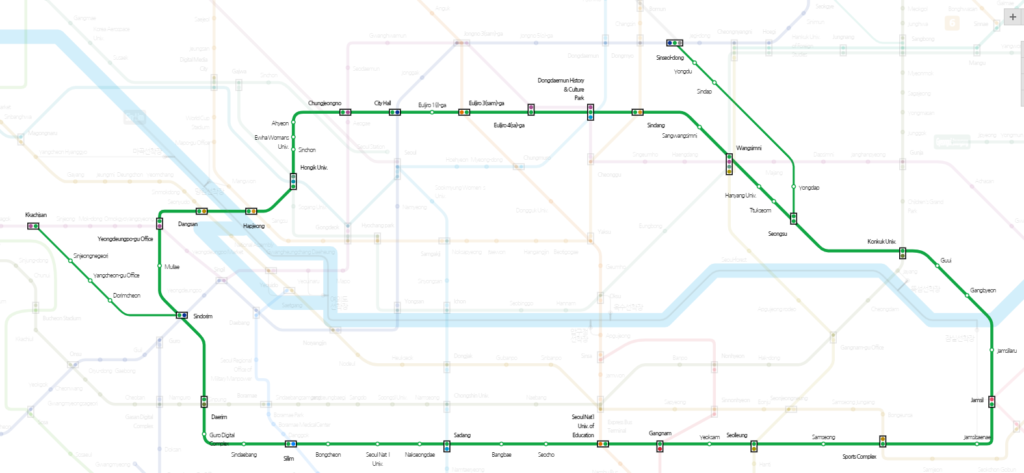
If there is one transit route that every international visitor to South Korea’s capital absolutely must understand, it is the Seoul Subway Line 2. This bright green circular loop connects virtually every major tourist district, university neighborhood, business hub, and entertainment zone in the city. Unlike other commuter lines that run point-to-point, Line 2 forms a complete circle through central Seoul, meaning you can hop on at any station and eventually reach your destination without ever needing a complex transfer.
In this comprehensive local guide, I will walk you through the top stations worth knowing as a tourist, share insider insights from my years of living and working along this exact route, and help you map out the most efficient sightseeing circle possible.
Understanding the Green Circle: Direction Tips
Line 2 is color-coded bright green on every digital transit map. It features 43 stations on its main circular track, along with two minor branch lines (extending toward Sindorim and Seongsu). For sightseeing purposes, the main loop covers everything you will ever need.
🚨 Crucial Rookie Mistake to Avoid: Because Line 2 is a loop, trains run indefinitely in two opposite directions: Clockwise (Inner Circle / 내선순환) and Counter-Clockwise (Outer Circle / 외선순환). Before tapping your card and stepping onto the platform, always check the destination signs on the glass screen doors. Boarding the wrong side won’t get you permanently lost, but it can easily turn a quick 10-minute commute into a frustrating 40-minute accidental tour around the city!
1. Hongik University Station (홍대입구역) — Youth Culture & Nightlife
Known affectionately by locals as Hongdae, this area is Seoul’s beating heart of indie art, live street music, vintage fashion, and legendary nightlife.
-
Daytime Vibe: Perfect for hunting down hidden second-hand clothing boutiques, independent bookstores, and highly photogenic themed cafes.
-
Nighttime Vibe: The energy shifts dramatically after sunset. Hongdae’s busking streets light up with talented dance crews and indie musicians, while its globally recognized club scene stays packed until dawn on weekends.
-
Expat Tip: Exit 3 connects directly to the Gyeongui Line Forest Park (nicknamed Yeontral Park by locals). It is a gorgeous linear park built over old railway tracks, ideal for grabbing a craft beer from a convenience store and enjoying a sunny afternoon stroll.
2. Sinchon (신촌역) & Ewha Womans University Station (이대역) — Trendy College Towns
Moving slightly along the loop, Sinchon and Ewha form a continuous academic belt. While Hongdae skews heavily toward arts and alternative nightlife, Sinchon and Ewha lean into budget-friendly local dining, affordable skincare shopping, and trendy dessert cafes curated specifically for university students.
The campus of Ewha Womans University itself is a major architectural tourist spot. The “Ewha Campus Complex” (ECC), designed by Dominique Perrault, features an incredible underground valley sliced directly into the earth that looks stunning in photos. The shopping streets leading up to the school gates are packed with incredibly cheap fashion boutiques.
3. Euljiro 1-ga Station (을지로입구역) — Business Hub & The Honest Myeongdong Shortcut
This specific station holds a deeply nostalgic place in my heart. My professional corporate office was located right in the middle of Euljiro, and I spent years commuting through these exact turnstiles daily. To locals, this station is just a busy office district, but for tourists, Euljiro 1-ga Station (Exit 5) is actually an incredibly convenient, less crowded backdoor gateway to Myeongdong.
Exiting through Exit 5 positions you right at the northern entrance of Myeongdong. The walk itself is fascinating—you transition instantly from Seoul’s glossy financial skyscrapers into a bustling alley packed with neon signs, cosmetics shops, and endless rows of street food carts.
⚠️ An Honest Local Truth About Myeongdong Street Food: While the street food stalls lining this entrance look incredibly tempting and photogenic, here is a reality check from a Seoul resident: local Koreans almost never eat here. In recent years, these stalls have become heavily commercialized and strictly targeted at international tourists. The prices are notoriously inflated (often double what you’d pay elsewhere), and the menus are curated for tourist novelty rather than authentic Korean tastes.
By all means, enjoy the vibrant, crowded atmosphere and snap a few photos, but if you want a genuinely authentic and reasonably priced Korean meal, skip the street carts and head into the smaller, hidden sit-down restaurants located in the back alleys of Euljiro or Myeongdong where local office workers actually line up for lunch.
4. Dongdaemun History & Culture Park Station (동대문역사문화공원역) — Futuristic Design
Commonly abbreviated as DDP, this station is home to one of Seoul’s most visually striking pieces of architecture—a massive, silver, curvaceous structure designed by the late Zaha Hadid that looks like a spaceship landed in the middle of an ancient fortress district.
Dongdaemun is famous for its massive night wholesale fashion markets. Unlike traditional retail malls, many buildings here cater to professional clothing suppliers and stay open from 8:00 PM until 5:00 AM the next morning. If you are looking to shop for unique, affordable Korean apparel at 2:00 AM, this is the only place to be.
5. Jamsil Station (잠실역) — Lotte World & Family Entertainment
Jamsil is a mandatory stop for anyone traveling with family or children. This station anchors the massive Lotte entertainment empire:
-
Lotte World: One of the world’s largest indoor theme parks, complete with an outdoor castle (“Magic Island”) floating picturesquely over Seokchon Lake.
-
Lotte World Tower: The 6th tallest building in the world. Head up to the Seoul Sky observation deck on the 123rd floor for an unparalleled panoramic view of the entire peninsula.
6. Sports Complex Station (종합운동장역) — The Unmissable K-Baseball Culture
If you want to experience an authentic local cultural phenomenon that goes beyond typical sightseeing, catch a professional Korean baseball game at Jamsil Baseball Stadium between April and October.
Korean baseball games are less about quiet sports observation and more akin to an electric pop concert. Every single batter has a dedicated, highly synchronized fan chant, led by enthusiastic cheerleaders on elevated stages.
The highlight of the experience is participating in Chimaek (치맥)—the classic pairing of Korean fried chicken and ice-cold draft beer. You can buy fresh boxes of chicken right inside the stadium concourse, sit in the roaring outfield stands, and cheer along with thousands of passionate locals. It is an unforgettable experience even if you have zero knowledge of baseball rules.
7. Gangnam Station (강남역) — Seoul’s Glossy South Side
Gangnam requires no introduction to global travelers. Acting as the commercial powerhouse of southern Seoul, the streets surrounding Gangnam Station represent the epitome of modern, affluent Korean urban life.
The underground shopping arcade stretching beneath the station is massive and excellent for scoring deals on casual clothes and phone accessories. Above ground, the towering skyscrapers house high-end corporate headquarters, luxury restaurants, trendy nightlife venues, and world-renowned plastic surgery and dermatology clinics that define the “K-beauty” phenomenon.
The Perfect 1-Day Seoul Subway Line 2 Itinerary
If you want to experience the absolute best of the green loop in a single, well-paced day, follow this optimized directional route:
[Morning] Hongdae (Coffee & Indie Streets)
   ↓ (Line 2 Green Loop)
[Late Morning] Ewha Womans University (Campus Walk & Affordable Boutiques)
   ↓ (Line 2 Green Loop)
[Lunch & Afternoon] Euljiro 1-ga (Walk into Myeongdong for Street Food & Skincare)
   ↓ (Line 2 Green Loop)
[Sunset] DDP (Futuristic Architecture & Photo Session)
   ↓ (Line 2 Green Loop)
[Evening] Jamsil (Lotte Tower Views) OR Sports Complex (Night Baseball & Chimaek)