
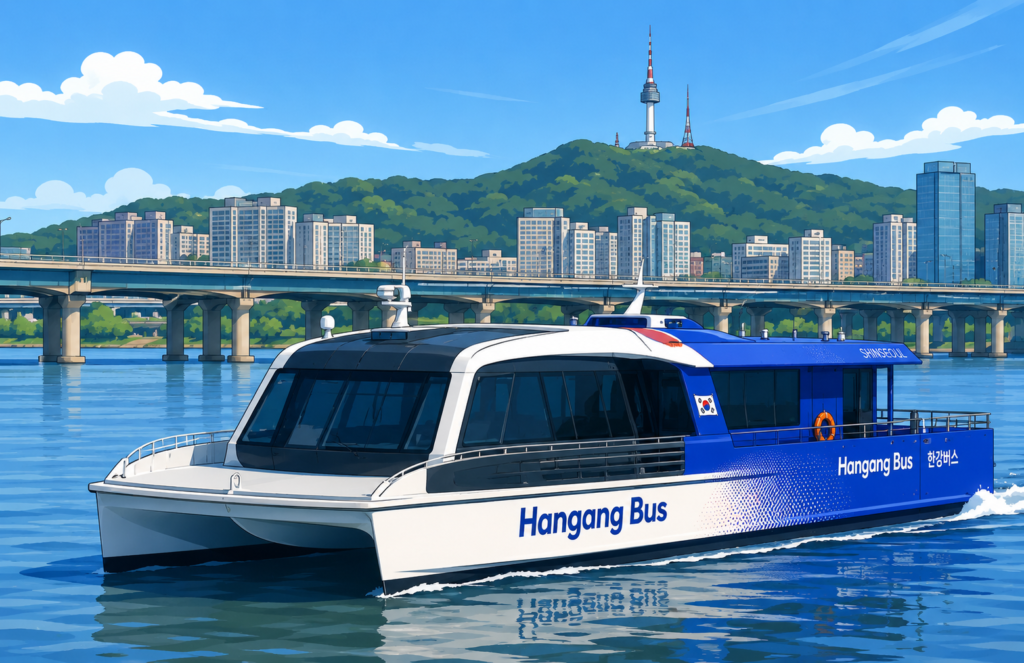
A few days ago, I was walking through Yeouido Park with my family when I noticed the Hangang River Bus pulling into the pier. Until then, I had mostly thought of it as a new commuter service that occasionally appeared in the news. Watching it arrive, though, I started wondering whether it might actually be one of Seoul’s most underrated sightseeing experiences.
Most visitors experience Seoul from underground subway tunnels, buses, or busy city streets. The Hangang River Bus offers something different: a chance to see the city from the water. Whether it is worth using as a practical transportation option is another question entirely.
In this 2026 guide, I will explain how the Hangang River Bus works, what to expect, and whether it makes more sense as a commuter service or a sightseeing activity.
1. What Is the Hangang River Bus?
The Hangang River Bus is Seoul’s official water transportation service operating along the Han River. Introduced in 2025, the service uses eco-friendly hybrid vessels designed to connect several major districts located near the river.
Current Route (2026)
As of 2026, the route is divided into two sections with Yeouido serving as the transfer hub.
Western Line
- Magok
- Mangwon
- Yeouido
Eastern Line
- Yeouido
- Oksu
- Ttukseom
- Jamsil
If you plan to travel between Magok and Jamsil, you will need to transfer at Yeouido.
Major Stops
Magok – Technology and business district
Mangwon – Popular local market and riverside area
Yeouido – Financial district and main transfer point
Oksu – Residential area with subway connections
Ttukseom – One of Seoul’s most popular riverside parks
Jamsil – Home to Lotte World Tower and major attractions
2. How Much Does It Cost?
The standard fare is:
3,000 KRW per ride
Passengers can pay using a T-Money card just like they would on buses and subways.
A useful alternative is the Seoul Climate Card.
Climate Card Benefit
The following Climate Card plans include unlimited Hangang River Bus rides:
- 67,000 KRW (Bus + Subway + Hangang Bus)
- 70,000 KRW (Bus + Subway + Ttareungyi Bike + Hangang Bus)
If you already plan to use the Climate Card during your stay in Seoul, the river bus becomes an attractive bonus rather than an extra transportation expense.
3. Best Scenic Route for Tourists
If your goal is sightseeing rather than commuting, the eastern section between Yeouido and Jamsil offers the most impressive views.
During the journey, you may see:
- Banpo Bridge
- Some Sevit (Floating Islands)
- N Seoul Tower in the distance
- Seoul skyline along the Han River
- Lotte World Tower approaching Jamsil
Unlike the subway, every passenger has access to river views throughout the journey. On clear days, the scenery alone can make the ride worthwhile.
If possible, choose a window seat for the best photography opportunities.
4. Connecting With Ttareungyi Bikes
One practical advantage of the Hangang River Bus is how well it connects with Seoul’s public bicycle system.
Most piers have Ttareungyi bike stations within a short walking distance.
A popular strategy is:
- Rent a Ttareungyi bike.
- Ride along the Han River cycling paths.
- Dock the bike near a ferry pier.
- Take the Hangang River Bus.
- Pick up another bike at your destination.
This combination allows you to explore much more of the riverfront without relying entirely on the subway.
For a complete guide, see my article on how to rent Ttareungyi bikes as a foreign visitor.
5. Is It Actually Faster Than the Subway?
Honestly, not usually.
If your only goal is reaching your destination as quickly as possible, the subway remains the better option in most situations.
There are two reasons:
Pier Locations
The ferry stops are located directly on the river. Many attractions are still a bus ride, taxi ride, or long walk away after you disembark.
Transfer Time
Traveling between the western and eastern sections requires a transfer at Yeouido, which can add extra time.
For daily commuters, speed may not always justify the route.
For tourists, however, the calculation is different.
Instead of spending thirty minutes underground, you spend thirty minutes looking at Seoul’s skyline from the water. Many visitors may find that trade-off worthwhile.
6. Check Service Status Before You Go
One important thing to remember is that river transportation is naturally more vulnerable to weather conditions than subways.
Heavy rainfall, special events, or river conditions can occasionally affect operations.
Before heading to a pier, check the official schedule or service notices for the day.
This is especially important during summer rainy seasons and major riverfront events.
7. Who Should Use the Hangang River Bus?
Good For
✅ First-time visitors looking for unique city views
✅ Travelers already exploring the Han River parks
✅ Climate Card users
✅ Families seeking a relaxed sightseeing experience
✅ Photographers and content creators
Probably Not Worth It For
❌ Travelers in a hurry
❌ People staying far from the river
❌ Visitors trying to maximize sightseeing efficiency in a single day
Summary Checklist for the Hangang River Bus
- The Hangang River Bus operates along the Han River with Yeouido as the main transfer hub.
- Standard fare is 3,000 KRW using T-Money.
- Climate Card holders can ride without additional charges.
- The Yeouido–Jamsil section offers the best sightseeing views.
- Most piers connect easily with Ttareungyi bike stations.
- The subway is usually faster, but the ferry provides a unique perspective of Seoul.
- Always check service status before traveling, especially during bad weather.
- Think of it as a sightseeing experience first and a transportation tool second.